ETH Zürich
Abstract
Dexterous grasping is fundamental to robotics, yet data-driven grasp prediction relies heavily on large and diverse datasets that are costly to generate and typically limited to a narrow set of gripper morphologies. Analytical grasp synthesis can scale data collection, but the required simplifying assumptions often yield physically infeasible grasps. These grasps must be filtered in high-fidelity simulators, substantially reducing both the number of retained grasps and their diversity.
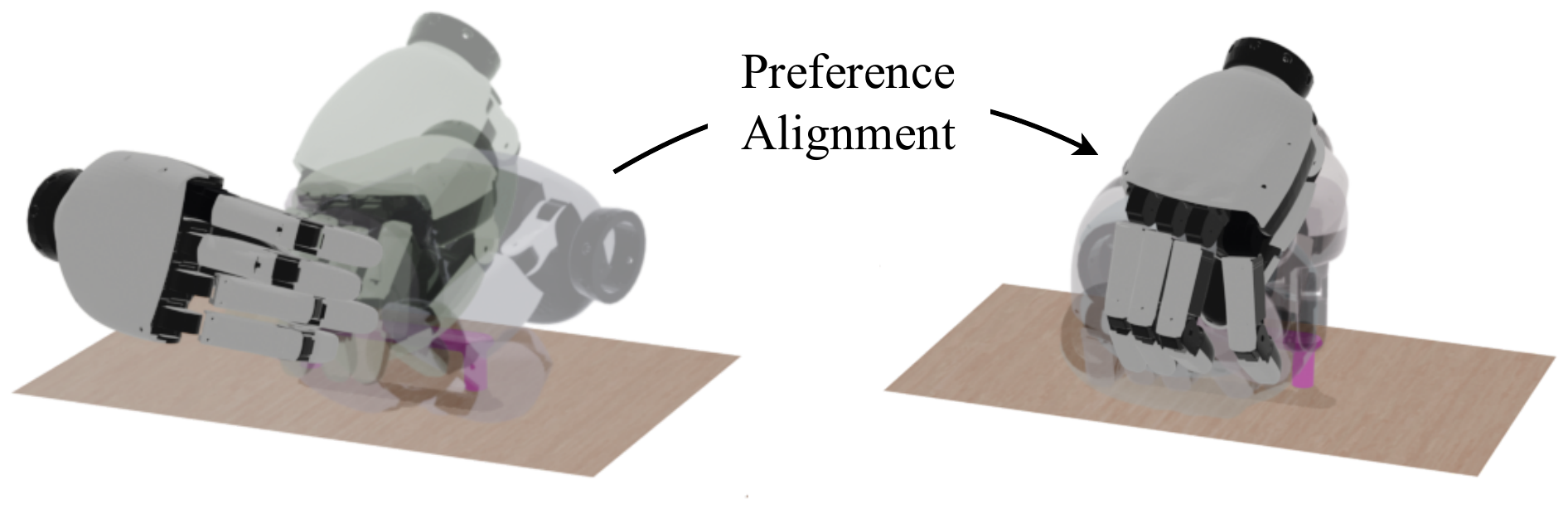
We propose a scalable generate-and-refine pipeline for synthesizing large-scale, diverse, and physically feasible grasps. Instead of using high-fidelity simulators solely for verification and filtering, we leverage them as an optimization stage that continuously improves grasp quality without discarding precomputed candidates. We initialize an evolutionary search with a seed set of analytically generated, potentially suboptimal grasps, and refine these proposals directly in Isaac Sim using an asynchronous, gradient-free evolutionary algorithm that improves stability while maintaining diversity. The refinement can further be guided by human preferences and domain-specific quality metrics without requiring differentiable objectives. We then distill the refined grasp distribution into a diffusion model for robust real-world deployment. Experiments on our newly introduced Handles dataset and a DexGraspNet subset show that the proposed method produces over 120 distinct stable grasps per object, a 1.7–6× improvement over unrefined analytical seeds.
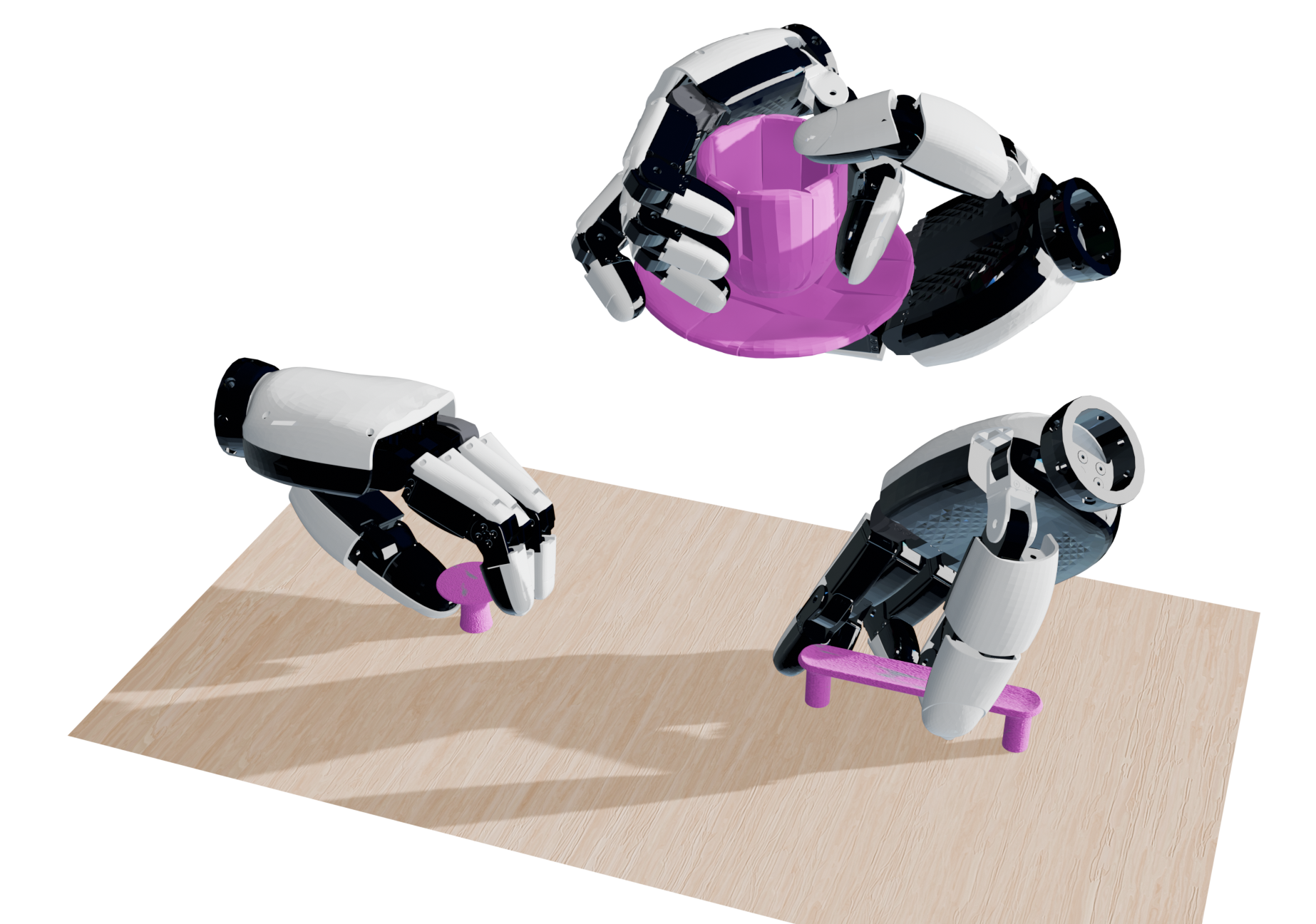
Refined grasps across the Handles dataset: 8 random grasps per asset, simulated in parallel.
Refined grasps on the Objects (DexGraspNet subset) dataset with the XHand.
Supplementary Video
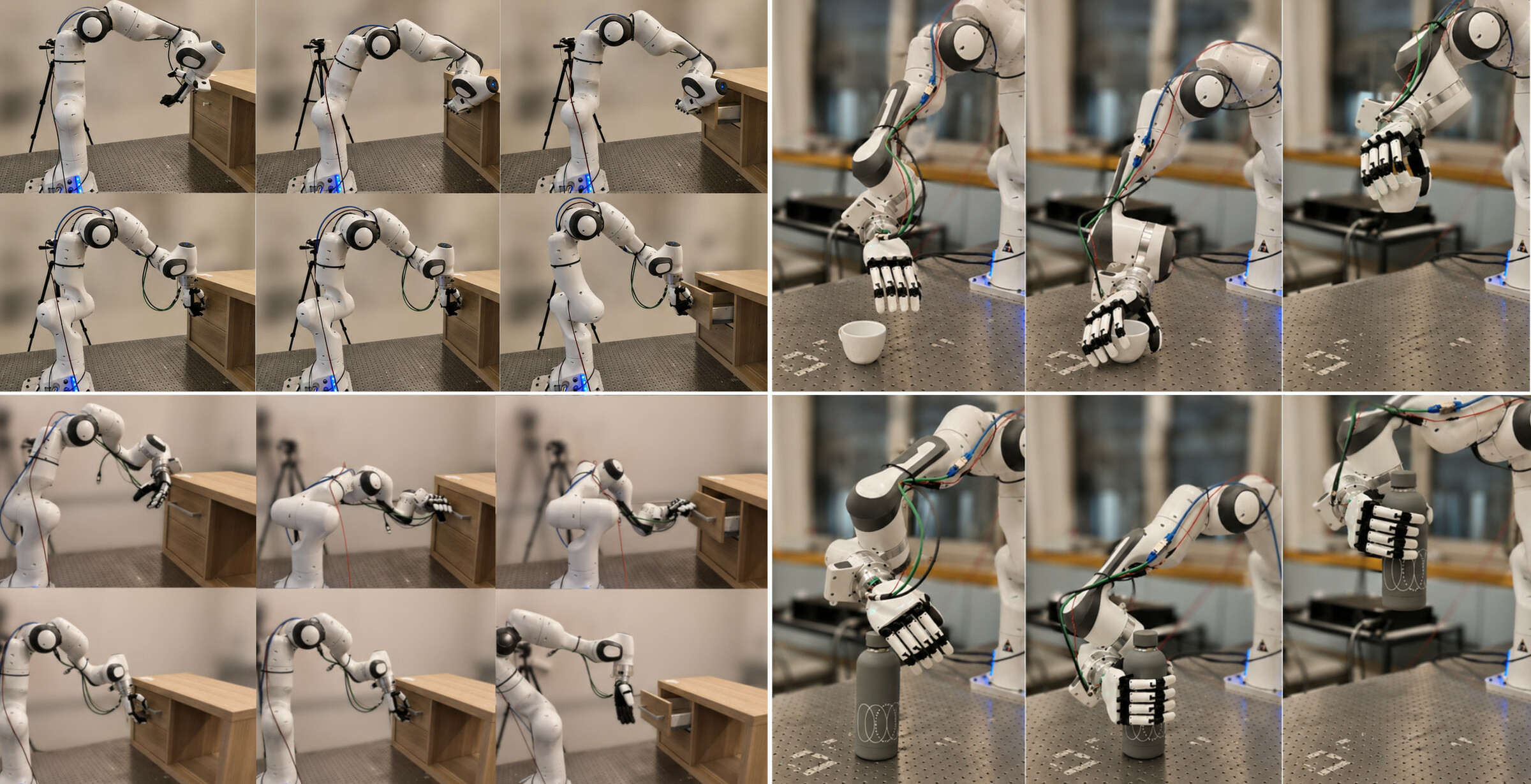
Hardware validation on a Franka Panda arm with a dexterous XHand: 20 handle-grasping trials (5 handle types × 4 grasp poses) and object pickup tasks. Sim-to-real transfer without fine-tuning, executed in real time.
Method
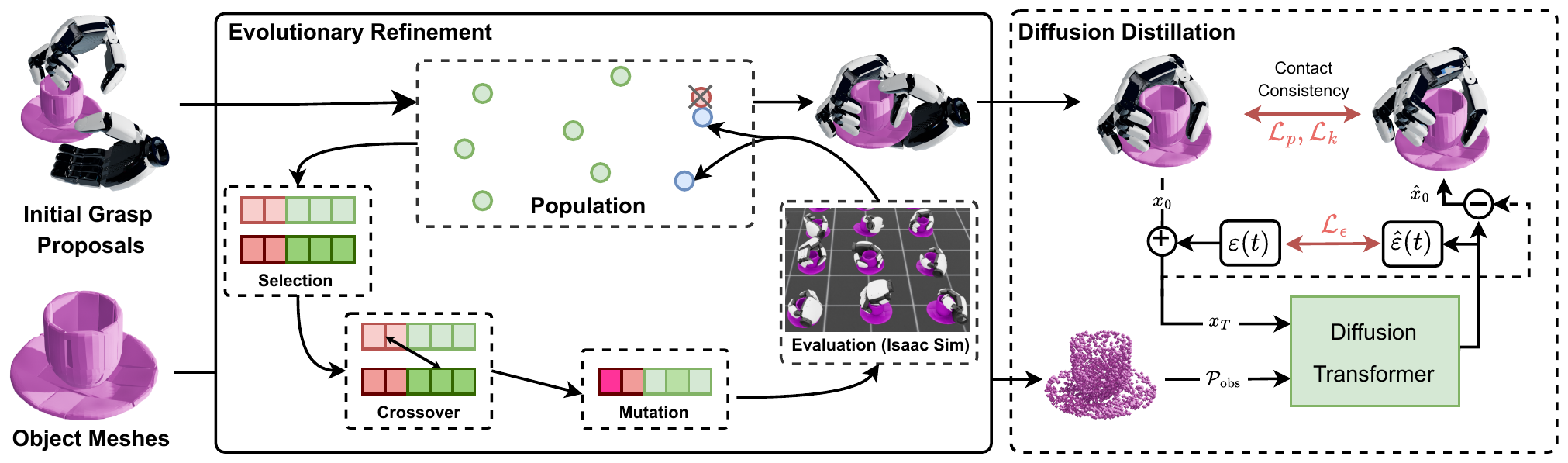
DexEvolve turns high-fidelity simulation from a binary accept/reject filter into a black-box objective that is optimized directly: instead of discarding failed seed grasps, it iteratively repairs and improves them.
A diverse seed set of grasp candidates is generated with an analytical optimizer (GraspQP). The framework is agnostic to the initialization strategy: any grasp generator, even random sampling, can provide the initial pool.
An asynchronous, gradient-free evolutionary algorithm refines grasps through massively parallel rollouts with early rejection. Density-aware selection and archive-based novelty insertion suppress redundant grasp clusters and prevent mode collapse, while contact points and grasping commands are adaptively resampled for each offspring.
The refined grasp distribution is distilled into a point-cloud-conditioned diffusion model that diffuses the full grasp configuration, including wrist orientation, with keypoint-consistency and penetration losses, enabling fast inference from partial, noisy observations.
Evolutionary sampling in Isaac Lab: fitness terms (Elifetime, Epenetration) evaluated live as the population evolves.
Adaptive contact-point resampling: active contacts are recomputed for every offspring and turned into grasping commands via the contact Jacobian.
Handles Dataset
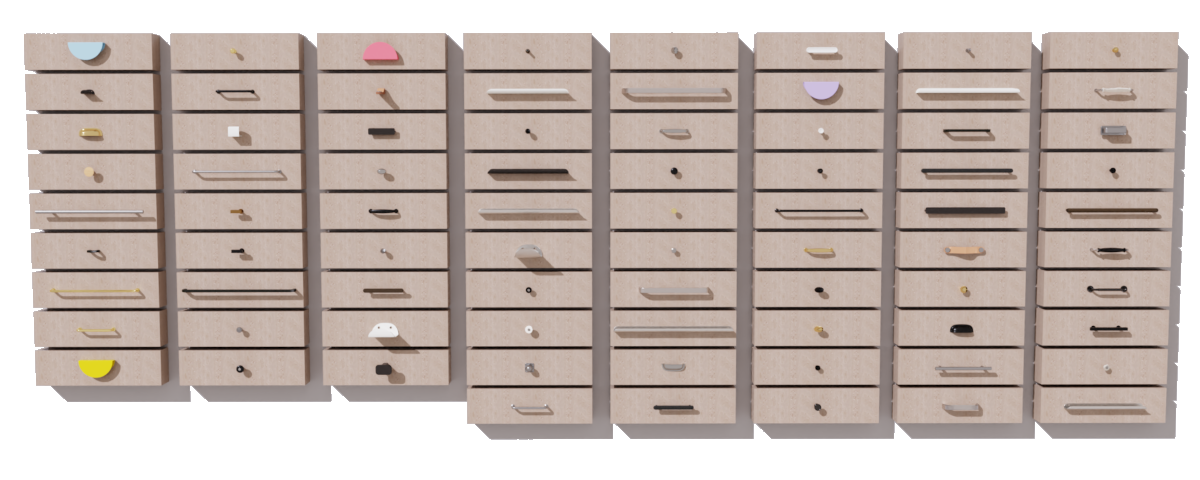
90 geometrically distinct door handle and knob assets with multiple texture variations, modeled after commercially available IKEA products, enabling reproducible evaluation and direct sim-to-real testing with physically purchasable hardware.
.usd
assets that work directly in Isaac Sim.Results
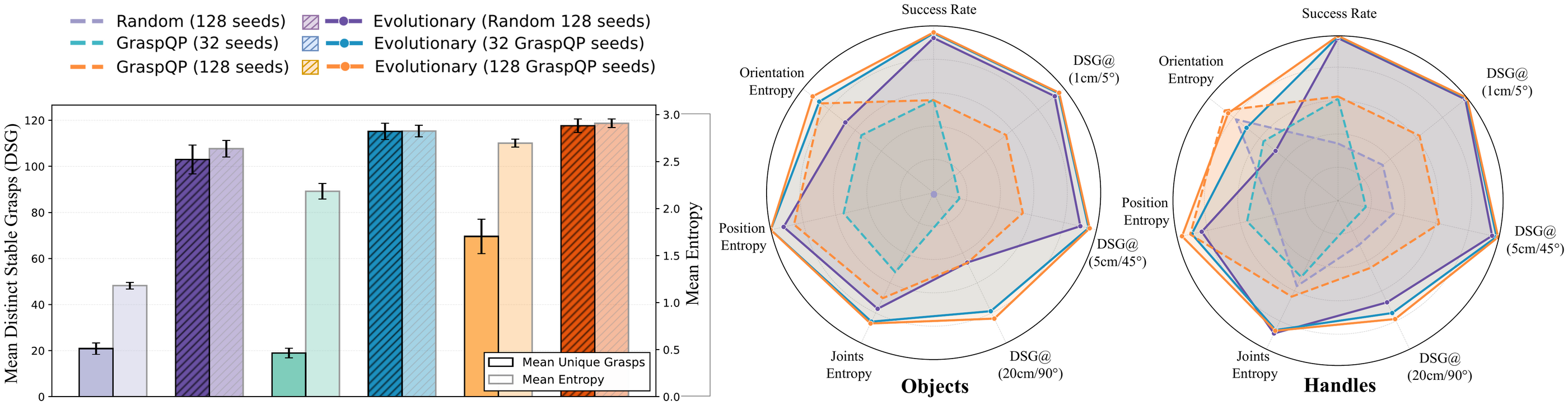
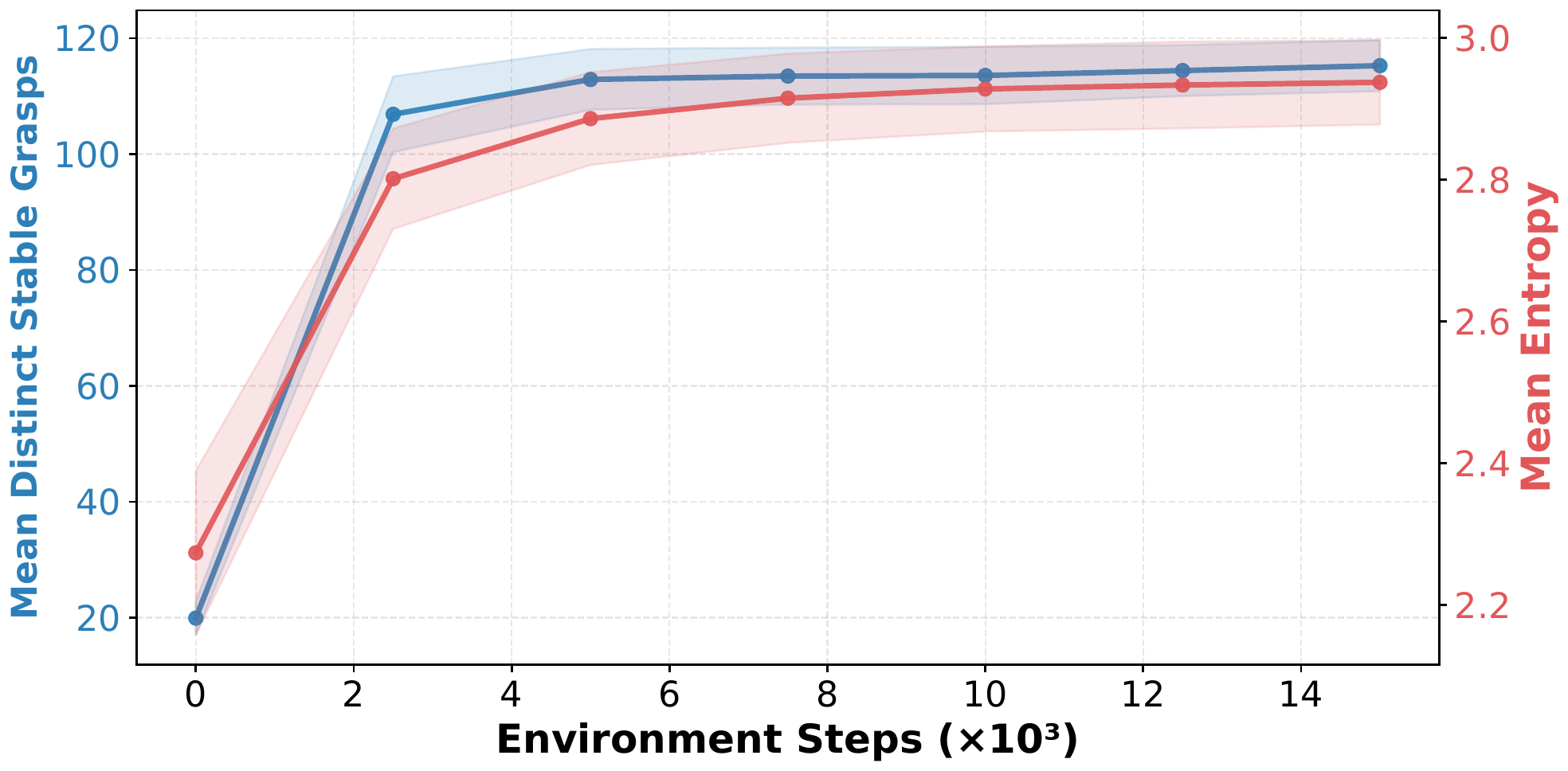
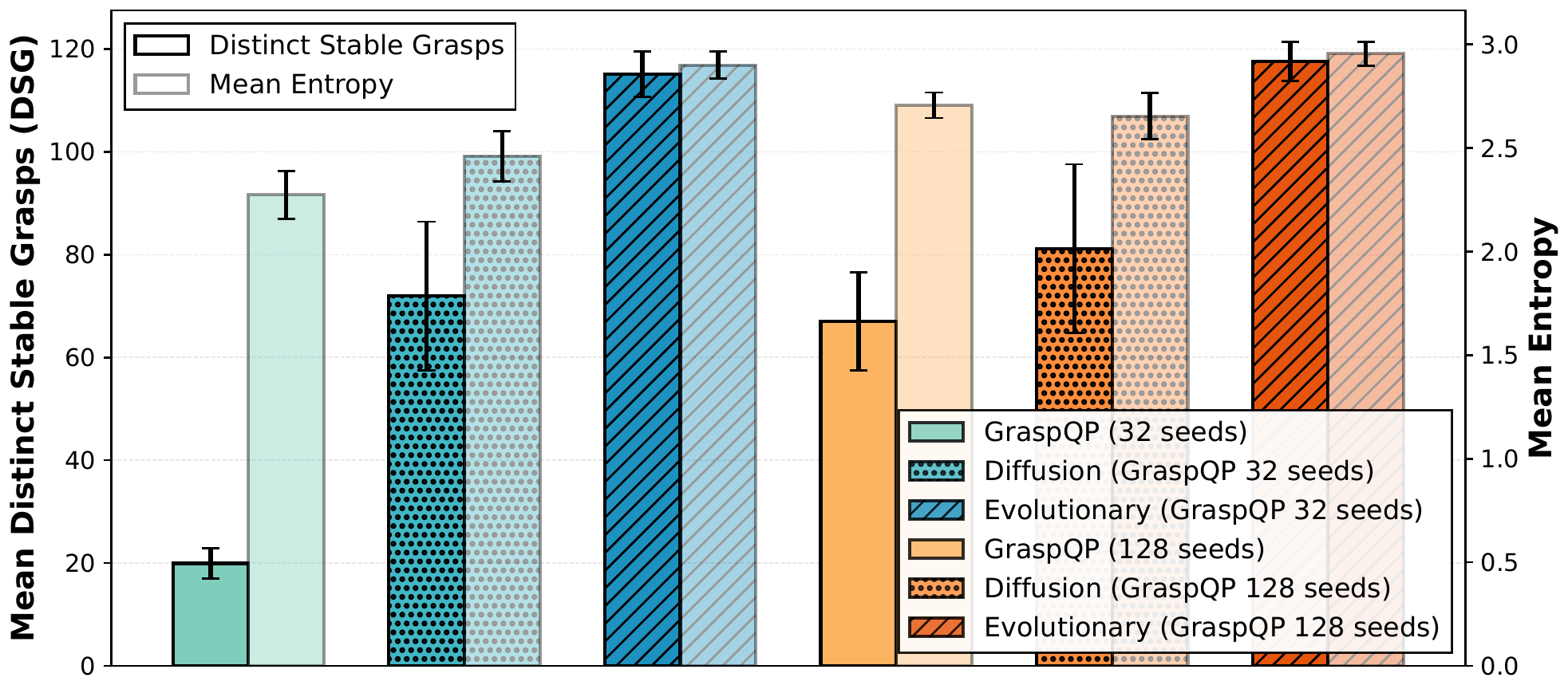
Evolutionary refinement consistently improves both stability and unique-grasp coverage across all initialization strategies and both datasets, improving distinct stable grasps (DSG) from 19 to 114 with 32 analytical seeds and from 69 to 118 with 128 seeds, while preserving or increasing entropy across position, orientation, and joint spaces.
The framework is hand-agnostic: gains are consistent across parallel-jaw and fully dexterous hands on Objects, using 32-seed GraspQP initialization followed by evolutionary refinement.
| Metric | Robotiq 2F | Robotiq 3F | Allegro | Shadow |
|---|---|---|---|---|
| DSG@5cm (seed → refined) | 9 → 80 | 25 → 86 | 25 → 123 | 17 → 110 |
| Entropy H (seed → refined) | 1.5 → 2.7 | 2.3 → 2.7 | 2.4 → 2.9 | 2.1 → 2.8 |
Bold = after evolutionary refinement. DSG@5cm counts distinct stable grasps at 5 cm resolution; H is the average entropy over position, orientation, and joint states.
Real-World Deployment
A Franka Panda arm with a dexterous XHand grasps handles, knobs, and household objects: multi-view RGB-D perception with DepthAnything-v3 depth alignment, grasp sampling from the refined diffusion model with collision-aware guidance, and cuRobo motion planning.
Diffusion denoising on a real point cloud: random noise → grasp prediction over 100 steps.
Handle grasping across 5 handle types × 4 grasp poses, executed in real time.
Household object pickup with grasps distilled from the refined distribution.
Citation
@article{zurbruegg2026dexevolve,
title = {DexEvolve: Evolutionary Optimization for Robust and Diverse Dexterous Grasp Synthesis},
author = {Zurbr{\"u}gg, Ren{\'e} and Cramariuc, Andrei and Hutter, Marco},
journal = {arXiv preprint arXiv:2602.15201},
year = {2026}
}